Wednesday, 6 November 2013

Most Reported Fungi of 2013


     Fan-shaped Schizophyllum commune, the most commonly-recorded fungus by
Fungimappers in 2013. Photo by Ray Palmer, CC-BY-SA.
With the dry, hot summer approaching the southern states of Australia, we say goodbye to the typical 'fungi season' in this part of the country and consider what a bountiful season it has been. Many Fungimappers will use this quieter time before the holiday-rush to organise the observations they made during the year and write up their records to send to Fungimap. So it is good time to report on what has been recorded so far to give you the opportunity to compare these against your own observations and reflect on what local conditions may have contributed to some species being more common in your area than in other years. 


We are, of course, still receiving records for 2013, and our office volunteers will be processing these as received so please send in your records when you have the chance. If you have any questions about how to send in your records, please feel free to contact us at info@fungimap.org.au.

Here are the 25 Most Common Fungi Recorded in Australia in 2013(Not including records made during the Fungimap 7 Conference in Rawson, Victoria. Details of these records can be found here.)

  1. Schizophyllum commune 
  2. Pycnoporus coccineus 
  3. Amanita muscaria 
  4. Amauroderma rude
  5. Gymnopilus pampeanus (also known as Gymnopilus junonius)
  6. Lactarius eucalypti 
  7. Armillaria luteobubalina 
  8. Boletellus emodensis 
  9. Amanita xanthocephala 
  10. Omphalotus nidiformis 
  11. Oudemansiella radicata 
  12. Bolbitius vitellinus 
  13. Cyptotrama aspratum
  14. Stereum illudens 
  15. Stereum ostrea 
  16. Coprinellus disseminatus
  17. Dictyopanus pusillus 
  18. Gymnopilus junonius 
  19. Macrolepiota clelandii
  20. Mycena cystidiosa
  21. Coltricia cinnamomea
  22. Hypholoma fasciculare 
  23. Mycena interrupta 
  24. Mycena kuurkacea 
  25. Mycena nargan

The dark brown cap of Oudemansiella radicata
contrasts against its white gills.
Photo by Patricia Harrisson, CC-BY-SA.

Lactarius eucalypti, seen commonly this year in
both Victoria and Queensland. Photo by Paul George, CC-BY-SA.


The genus Mycena was well-recorded this year in Victoria. This Mycena cystidiosa was seen  during the Fungimap VII Conference in the Moondarra State Park. Photo by Bob Rowlands, CC-BY-SA.


Recorders in Victoria, New South Wales, and Queensland have been busy, contributing the most number of records to Fungimap this year. Perhaps political upheavals in Canberra this year can be blamed for the solitary record received from the Australian Capital Territory and, sadly, yet another year has passed without any records from the Northern Territory. 

As always, groups and passionate individuals make a huge impact on citizen-science efforts around the country, helping people to connect with other similar-minded fungiphiles and build skills in identifying and recording species. Over 70% of Victoria's records this year were submitted by the Fungi Group of the Field Naturalists Club of Victoria, and the Friends of the Westgate Park's fungi foray in July 2013 resulted in a great little list of fungi present in this beautiful sanctuary in Melbourne. The Queensland Mycological Society, co-organisers with Fungimap of the 2014 Queensland Fungi Festival in Brisbane, sent in 94% of the records from that state so far this year; the Fungi Festival in April 2014 will be a great opportunity to meet with members of this keen fungi group and get tips for starting a similar group in your area (Northern Territorians, we are looking at you!) 

Individuals make a phenomenal impact as well, especially when they are able to cover a patch in an area of Australia where few records are otherwise received. Genevieve Gates and David Ratkowsky of Tasmania gave in to Fungimap the records they had been making for the past couple of decades, totalling over 55,000 observations! A singular achievement, and great role-models for Australian fungiphiles.

We were happy to see that 19% of  records this year were accompanied by photographs, a steady increase over 2012's 15%. Photographs of key characteristics on the fungus, such as the gills/pores/gill folds, the stem, etc can be very helpful to our volunteers who attempt to confirm the determination of each record that is submitted before it is entered in the National Australian Fungimap Database.


Here are the Most Common Sightings in 2013 by State:


Victoria
Caps of Coprinus comatus turning to black
ink at maturity. Photo by Malcolm McKinty, CC-BY-SA.
Gymnopilus pampeanus
Armillaria luteobubalina
Bolbitius vitellinus
Schizophyllum commune
Amanita xanthocephala
Lactarius eucalypti
Mycena cystidiosa

Stereum ostrea


New South Wales
Amanita muscaria
Ceratiomyxa fruticulosa 
Omphalotus nidiformis


Queensland
Boletellus emodensis
Pycnoporus coccineus
Coltricia cinnamomea
Trametes modesta
Lactarius eucalypti
Trametes hirsuta


Western Australia
Fragile branches of the distinctive slime mould
Ceratiomyxa fruticulosa.
Photo by Sarah Lloyd, CC-BY-SA.
Amanita muscaria
Fuligo septica

Gymnopilus junonius

Tasmania
Cyttaria gunnii
Ileodictyon cibarium
Poronia erici

Tubaria rufofulva

ACT
Fuligo septica


South Australia
Abortiporus biennis
Coprinus comatus

Morchella elata/conica

Pycnoporus coccineus, the second-most recorded fungus of 2013.
Photo by Robert Bender, CC-BY-SA

Cyttaria gunnii can be found growing on Myrtle Beech.
Photo by Richard Robinson, CC-BY-SA.
Fuligo septica is said to look like scrambled eggs, or dog-vomit.
Photo by Lynn Alison, CC-BY-SA.

Wednesday, 16 October 2013

The Svampvänner (mushroom friends)

A Report from the Swedish Mycological Society Week 16-22 September 2013

Words & Images* by Alison Pouliot

A lectotype for Homo sapiens?
Statue of Carl Linnaeus in
Humlegården Park, Stockholm.
Sweden - the home of both Carl Linneaus and Elias Magnus Fries - seemed a promising land to participate in the Mykologiveckan, or mycological week of the Swedish Mycological Society this glorious European autumn. Having spent the last dozen years trying to get my tongue around multisyllabic German fungal common names such as gallertfleischiges Stummelfüßchen (Crepidotus mollis), I was then confronted by further linguistic gymnastics with Swedish names including rödskivig kanelspindelskivling (Cortinarius semisanguineus). So much for Linneaus' system of binomial nomenclature! This is, however, my only quibble (but in truth, delight in the quizzical riddles of language) of the most memorable few days among some of the friendliest and most knowledgeable mycologists and fungal enthusiasts I've ever encountered.

Sweden has a long mycological history with the Stockholm Mycological Society founded in 1879 and the Swedish Mycological Society (SMF) exactly a century later. The SMF aims to promote knowledge of fungi as well as producing the Swedish Mycological Journal, Svensk Mykologisk Tidskrift, and runs an annual Mykologiveckan among other activities.

This year's mycological week was held about 40km southwest of Stockholm at Hagaberg in the municipality of Södertälje (possibly better known for the manufacture of Scania trucks than fungal curiosities). A coterie of folk in gumboots (fancy Swedish lace-up ones) with dangling magnifiers and baskets slung over arms was a definite clue I'd arrived at the right place. Within moments I was bustled into a van with a dozen others and off we headed, whizzing by glistening lakes and forests of turning birch.

In a similar format to many mycological gatherings, each day began with a foray to various designated field sites. Sweden has various nature reserves and national parks in close proximity to Stockholm and many of these are among the 70 field sites that were surveyed by the 70 participants during the week. The country's 28 national parks and 3200+ nature reserves protect about 12% of Sweden's ecosystems, roughly equating with the area of land protected in Australia.

Map of sites surveyed for fungi.
On arrival at the Stora Alsjön Nature Reserve I was delighted to note that the reserve's information board acknowledged the Third F in mentioning that rare Sarcodon species (S .fennicus, S. glaucopus, S. versipellis, S.lundellii and S. scabrosus) are protected. Stora Alsjön is recognised for its high natural values and also has the highest number of RED-list fungi in coniferous forests within the Södertälje municipality. The group then dispersed into the forests and mires and among the lichen-carpeted boulders, sporadically reappearing with whoops of excitement at the discovery of a rare or curious fungal specimen. RED-listed species recorded included Boletopsis grisea, Tricholoma colossus and Sarcodon squamosus.

A perfect lunch spot in
Stora Alsjön Nature Reserve.
As well as being an exceedingly handsome fungus, Sarcodon squamosus has also been used to prepare dyes.


 Tricholoma colossus is ectomycorrhizal with Pinus sylvestris and is characteristic of 'natural' or 'near-natural' oligotrophic pine forests. It is considered critically endangered on a European scale,
its main threats being silvicultural intensification and eutrophication.

Sweden has developed an interesting system to assess biodiversity based on various indicator or 'signal' species that includes flora, fauna and fungi. The system is used to locate and identify forests and ecosystems with high natural values. Some species, for example, Phellinus pini, Tricholoma matsutake and Fomitopsis rosea, are indicative of old forests.

Although fungal foraying is rarely considered a sport (relative, for example, to the twitchers' 700 club) there was a definite sense of spirited competition between foray groups to see which might record the greatest number of species; the record being a remarkable 210 species on one foray. While Australia may be able to boast a greater (predicted) fungal diversity than Sweden, the sheer biomass of fungi in Sweden is something less commonly experienced in Australia, at least in dryer regions. Old logs were literally covered in hundreds if not thousands of fruiting bodies of various Hypholoma, Coprinus, Armillaria and Flammulina species among others, all working away relentlessly to convert wood to soil. Among the mycorrhizal species, fruit bodies were encountered with every step, members of the Russulaceae being especially abundant.

Following the field trips, the rest of the afternoons were spent with noses jammed in microscopes as the identities of collected specimens were diagnosed, debated and databased. As with most mycological societies, there are those who are interested in the whole gamut of fungi and those who specialise in particular groups. Birgitta Wasstorp is one of Europe's most experienced Russula experts, Bo Nylén specialises in the genus Agaricus, Åke Strid with Aphyllophorales, Lennart Söderberg with Ramaria and Lennart Vessberg with Hygrocybe. Chairman of the Stockholm Mycological Society, Mattias Andersson, is an expert on fungal dyes, especially the various species of the Cortinarius subgenus Dermocybe that contain the different anthraquinone dyes. Active fungal-dyer, Karin Engerström-Gerstel was attired in fungal-dyed hand-knitted morels and russulas! Both participated in the International Fungi and Fibre Symposium held in Denmark, Australia in 2003.

Once identified, species were documented and placed on a table for the gate-keepers to confirm identifications before they were assigned to the display room. On the final day, these specimens formed an exhibition for the public to experience the great diversity of fungi found in local forests.

 Karin Engerström-Gerstel
in 'mushroom-wear'.
Hygrocybe punicea is possibly the largest member of the genus.


Boletus luridus forms mycorrhizal relationships deciduous trees including birch, beech and oak.

The following day I forayed with a different group in the Lida Nature Reserve, led by Michael Krikorev. Among the old spruce (Picea abies) and pine (Pinus sylvestris) we came across RED-listed species including, Pycnoporellus fulgens, Boletopsis leucomelaena, Hydnellum suaveolens, Artomyces pyxidatus and Onnia tomentosa. The first two species along with Lactarius scrobiculatus are also 'signal' species that were found on the foray.
 Michael Krikorev holding
Amanita magnivolvata.
 Johan Möllegård sniffs a Russula sp.

Swedish Mycological Society forayers at Lida Nature Reserve.

The Kantarell and the Krona

One notable difference between a Fungimap conference and a Mykologiveckan is that there is a second element to Swedish foraying - foraging for edible fungi, especially Cantharellus cibarius and Craterellus tubaeformis. While some participants are interested only in taxonomy and some only in edible species, many were interested in both taxonomy and the collection of edible species and were hence armed with collection boxes for specimens and baskets for edible species. The Alle Mans Rätt (The Rights of All Men) is an ancient Swedish customary law that allows any person (presumably including those sans a Y chromosome) to freely roam and pick mushrooms and berries for one's own consumption.

 A basket of freshly plucked
Craterellus tubaeformis
and Hydnum repandum.
The person deemed responsible for piquing interest in edible fungi in Sweden was the French Marshal Jean-Baptiste Jules Bernadotte (later crowned Karl XIV Johan). Famine, resulting from centuries of warfare in continental Europe and Russia, has historically been a driver of edible mushroom foraging in many European countries including Sweden. While, according to Swedish Freak, the new king encouraged the consumption of Boletus edulis (renamed to Karl-johans-svamp in King Karl's honour) it is definitely the chanterelle, or Kantarell, that seems to carry more currency than the Krona in Sweden today.

 One of the most exciting aspects of the field trips for me personally was the incredible diversity and abundance of lichens. There seemed to be barely a square centimetre of soil, rock or wood that hadn't been colonised by at least one and usually multiple species of this group.
 
 Lichen-moss wonderland in Stora Alsjön Nature Reserve. 
Cladonia coccifera is recognisable
by its bright red apothecia.
Cladonia rangiferina is a primary food source for reindeer.

Rhizocarpon geographicum on pink granite.


 Fungal Conservation in Sweden

While fungi have been included in biodiversity conservation in Sweden if the RED-listing of 746 species is anything to go by, the reality is that - as in Australia - there is only one mycologist position with a focus on macrofungal taxonomy, ecology and conservation, shared by Anders Dahlberg and Michael Krikorev. The fungi, however, are relatively well-known given the long tradition of mycology and the enormous contribution of interested fungal enthusiasts. There are believed to be 12,000 plus species of fungi in Sweden (including 5000 macromycetes and 2000 lichenised fungi) with most of the 5000 macromycetes having being considered for the 2010 Red List.

Many issues related to forestry and the clearing of old-growth forest pose a threat to RED-listed fungi, especially given that 85% of RED-listed fungal species occur in forests. As in Australia, those species restricted to old dead wood are especially threatened by the removal or destruction of their habitat. Another major threat is changed soil nitrogen levels.
 Leccinum vulpinum.
Mycena galericulata.
Stropharia hornemannii.
In an effort to increase public awareness of biodiversity, in 2002 the Swedish Parliament commissioned the Swedish Species Information Centre (SSIC) to identify all species of multicellular flora, fauna and fungi - focussing especially on poorly known groups - as part of the Swedish Taxonomy Initiative. However, despite the recording of 2,400 species new to Sweden (with at least 900 of these being new to science) the program has been crippled by recent budget cuts and its future looks bleak. However, various other conservation initiatives persist and every fifth year the SSIC reviews Sweden's RED List that currently has 4127 species listed and proposes new species.

Following the conference I headed to Stockholm to see the Wild Wonders of Europe photographic exhibition, the 'largest photography-based conservation communication initiative in the World', which featured biodiversity images from 48 European countries. While rewilding remains a controversial subject, the exhibition contained some powerful images and conservation success stories. Fungi only featured once, with an image of Marasmius androsaceus (horsehair parachute mushroom) from Pripyatski National Park in Belarus, but a least that's one more fungus image than in many exhibitions on biodiversity.

During my stay in Sweden, I thought I'd try and understand something of Swedish history via Kerstin Ekman's famous novel, 'The Forest of Hours', especially given I spent a week hiking in the world heritage-listed Skule Forest where the book is set. Its central character, a paradoxical troll named Skord, lives in the forest on the outermost fringes of society among the misfits and eccentrics (mycologists?). In the fading light on my last evening in this other-worldly forest, I admittedly made more than one sideways glance among the ferny glades for a wayward troll. I captured my last photograph of an especially lanky Stropharia semiglobata sprouting from a pile of moose pellets. As I wrangled my tripod into position, I felt a distinctive squishiness beneath my left knee, only to discover that I'd knelt in something else's freshly laid and impressively large excreta. For the record, I photographed the semi-squashed deposit. Later that evening, in the splendid company of Jacob Näslund, who once owned much of the land before it was acquired by the Swedish government and labelled as world heritage in 1972, I showed him the picture of my knelt-in deposit. His moustached lip curled into a grin as he chuckled and casually commented 'Well, that'll of course be a bear...'. Gulp. I'm certainly glad neither bear nor troll tapped me on the shoulder in the twilight forest as my shutter snapped shut on my coprophilic subject.


Stropharia semiglobata in moose pellets.
A troll lair?
Another troll lair?


Now in the supposed safety of a reinforced titanium capsule at 35,000 feet, I type this piece while listening to a track from psybient Swedish duo Carbon Based Life Forms. An overdubbed voice repeatedly asks 'What about the forests'? A pertinent question. What about the forests? With the last tracts of 'old-growth' forest under threat in Sweden, Australia and elsewhere, what are the ways in which we might consider, re-imagine and activate the conservation of the fungi that inhabit these forests? Of all biodiversity? How can we incorporate the many ways they are considered, experienced and valued by mycologists and mycophagists, farmers and foresters, bears and trolls and countless others?

Carbon Based Life Forms was recommended by Anders Dahlberg's delightful son, Jonas. 'What a great band name', I'd commented as we tucked into some tasty chanterelles. Jonas had looked at me sideways, then resignedly yet graciously commented, ' Yeah, all biologists say that...'

What about the forests?

Huge thanks to Mattias Andersson, Michael Krikorev, Bengt Boström, Johan Möllegård, Lena Wallqvist and Jan Karp for their help with this article and to all those at the Mykologiveckan for their hospitality, enthusiasm and expertise. Also to Anders Dahlberg for showing me the forests north of Uppsala and for accommodating me.

*Most images available for use, please contact Alison for details.

Tuesday, 2 July 2013

Fungal FUN in New Zealand


Fungi event report #1: Fungal FUN in New Zealand: Report from the 27th NZ fungal foray


By Sapphire JM McMullan-Fisher


This is the first year I have managed to attend the FunNZ (Fungal Network of New Zealand). Far from being an infrequent event, this was the 27th NZ fungal foray. Each alternating year this group of enthusiastic fungiphiles visit somewhere in the north or south island for five fungi filled days. Check out their website if you want to find out more – the next one might be Stewart Island?
This years’ event was held in Matawai, midway between Opotiki and Gisborne, in the East Cape region of the North Island. The Matawai location was the impetus to finally get me to a FunNZ foray. In 2010 I made it back to NZ after 30 years, to go to the Childs Workshop - similar to fungi forays but this group are interested in Mosses, Liverworts, Hornworts and Lichens so their workshops are held in November most years. While at the 2010 Childs workshop, I was awed by some of the Nothofagus, podocarp and broadleaf forests (Fig. 1) and said to Shirley Kerr that I would give my eyeteeth to see these forests in the fungi season. So now, at last, I have. My wallet is a bit lighter but I still have all my teeth and I had a wonderful time!

What a great week we had with the folk from FunNZ. A lot of behind the scenes work goes on before such events: about 20 potential foray sites had been checked out, directions and maps worked out and permission and collection permits obtained for the whole group. This meant that each day, drivers would write down where they were going and how many gaps there were in their cars. Thus forays were self-selecting. Everyone was so friendly and knowledgeable that I wanted to go everywhere with everyone. So, after breakfast or the evening before, Roz Hart (Fig. 3) and I would plot and plan our fungal foray wish list for the next day. Each day turned out to be a great adventure with good fungi and lovely company. 

Figure 1: Broadleaf rainforest with red and silver beech (Nothofagus fusca & Nothofagus menzeseii) and emergent Rimu (Da crydium cupressinum). Photo: SJM McMullan-Fisher, CC-BY-SA
Figure 3: Roz Hart in Moanui.
Photo: SJM McMullan-Fisher, CC-BY-SA
Figure 2: The location of Matawai, on the North Island.
Source: Google Maps.


Figure 4: Wanda Daley (left) and Shaun Pennycook adding data to the New Zealand Fungi Database. Petra White hovers behind the scenes making sure the whole process goes smoothly. Photo: Roz Hart, CC-BY-SA
After each foray, everyone would return to the hall where we were based. In there, under much warmer conditions than outside, microscopes, cameras etc were set up ready to use. Most importantly, some of the collections staff from Landcare Research (a bit like one of our state conservation departments and herbarium combined) had set up tables for identification (see Figure 4). Plus a huge bundle of Foray labels each with a unique number and bar code. By bringing back a reasonable example of most of the taxa seen at each site and then databasing it straight away, there are good lists of the fungi observed over the long years of the NZ forays. Laying out of the specimens was ordered if appearing chaotic, new collections went on one table with a minimum of the site collection details on each label and whatever level of identification was worked out, and named specimens were databased as a priority, these moved from the left of the databasers to their right after they had been databased. Often by the time that they had been databased identifications had been made thus looking at the “done” table each night was a great way to learn new species (see Figure 5, below).
 
Figure 5: The “done” specimen table. Note the many species of named Cortinarius!
Photo: Roz Hart, CC-BY-SA
From the “done” table there was an opportunity to note unusual records or rarely collected taxa which were then immediately vouchered after databasing. In recent years these collections have been analysed for DNA so eventually there should be a good voucher collection for each New Zealand fungal taxa – so systematically developing a “Reference Collection”. Of course, these processes have developed over time, as small, logical improvements have been codified and worked into their system. As Petra White notes, there was a time when the group struggled (as many fungal groups do) with organising all the tasks that are required post-foray. She says, "When I attended my first foray (17th fungal foray, Katikati,, 2003) there was no system at all. The only lists that were recorded were those that were taken back to the PDD. I started recording by hand everything that was collected and also organising the process. There was no system at all and all the specimens, whether identified or not, were just lumped together on one table. I put in place the process that we still use, a table for unidentified, one for identified, and another for databased collections. From the databased table a decision is made as to which collections go to PDD. Some get labelled “Jac” and go to Jerry Cooper, and some others “OTA” and go to the Otago herbarium. It is also possible for individuals to take specimens of their own once they have been databased. In 2005 at Ohakune I was able to stop recording species lists by hand when Shaun turned up with a computer. In 2006 the FUNNZ tracking system was instituted and photographs of collections were taken in addition to the other information that was collected."

The level of identifications of the species found is very high. Many people have taken on “pet” groups and become familiar with their local species, both named and un-named. All the locals know who understands the different groups and direct you to the right person to go and ask questions. So say if you have a Mycena or Bolete you are directed to Patrick Leonard, or if it is an Entoloma or wax gill you are sent to Shirley Kerr or if it is a Psathyrella you see Mahajabeen Padamsee, for Cortinarius you get sent to David Orlovich and Karl Soop, if it is a bracket on wood you get sent to Peter Buchanan, and if it is obscure you get sent to Jerry Cooper!

There is the “field book”, which contains most species, a version of this can be found at http://www.landcareresearch.co.nz/resources/identification/fungi. There are a number of “guides” or manuals where those interested in the group have pulled together images, text and even made draft keys to the local species within the group. These are not polished documents but rather a place to bring together information so that the differences between species can be worked out. So some species might just start out with a tag name and an image and a few descriptive sentences. This may then evolve to several images, several pages of text about the species both macro and microscopic and even a trial key.

Everyone is very keen on fungi and the developing fungal knowledge is awe inspiring to see. This group may only get together for a week a year but in that week they pack in conversations about taxonomy, nomenclature, ecology, molecular work, conservation and all things mycological. It’s lovely to see that enthusiastic beginners are made welcome. It is a great place to learn about fungi and the congenial atmosphere, good humour made it all so easy and fun.

In the middle of the event was the “Mycology Colloquium” which was a fascinating day of talks about all things mycological. I think this was a wonderful opportunity to see the interests and also research which is going on in NZ. It was fabulous to see some students researching fungi. At the end of the day Jerry Cooper introduced to a website NatureWatch – Fungi NZ. (If you want regular internet fixes about what fungi are popping up in NZ you should join up – or even post the fungal delights you find when foraying in NZ!)

The delightful “Truffle Lady” (Teresa Lebel) was present – no surprise there as NZ appears to be another hot spot for wonderful truffle like fungi (second only to Australia of course?!) New to me were – red pouch fungi (Leratiomyces erythrocephala) (Fig. 7, below), Rossbevera pachyderma and Cortinarius porphoroides (pouch fungi).
Figure 6: The delightful “Truffle Lady” (Teresa Lebel) at Wairata. Photo: SJM McMullan-Fisher, CC-BY-SA.


Figures 7 (left) and 8 (right). 
Fig. 7: Red pouch fungus (Leratiomyces erythrocephala) found under Rimu (Dacrydium cupressinum). This fungus is is a truffle relative of the mushroom Leratiomyces ceres that is commonly found in mulch. The
fruiting bodies (below) are compared to a Passiflora berry (above). It is thought that Red pouch fungus is spread by animals due to the similarity in colour and form to plant berries. Fig. 8. The fungus being photographed and collected by Japanese mycologist Takamichi Orihara. Photos: SJM McMullan-Fisher, CC-BY-SA

Figure 9: Rossbeavera pachydermus. This truffle stains blue and has chololate coloured gleba. The genus was named after the wonderful New Zealand mycologist Ross Beever, who sadly passed away in 2010. He is still much missed at the Foray. Photo by: SJM McMullan-Fisher, CC-BY-SA


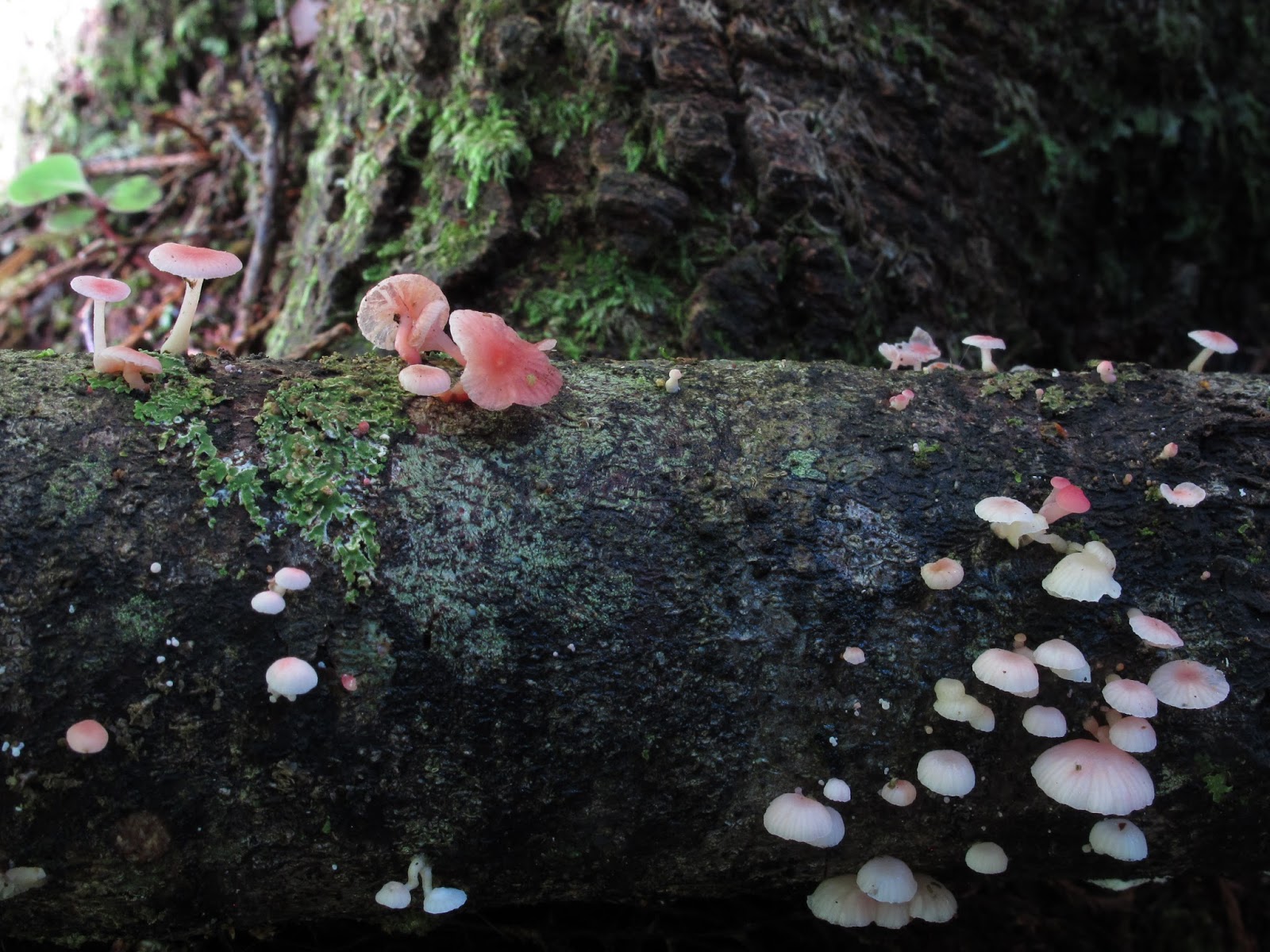
Other mycological highlights were Mycena roseoflava (see Figure 10), Mycena flavovirens (Fig. 11) and and Mycena interrupta (Fig. 12). While these are very common species in New Zealand, Mycena as a genus was quite a highlight of this foray because of the many different substrates it was found on, such as Dicksonia spp.

These delicate and colourful species brought great photographic opportunities. There was also a welter of Cortinarius species particularly under Nothofagus. Here again it was interesting to find Cortinarius (C. cycneus) growing in Blechnum discolor and Astelia nervosa; the mycelium obviously extend up into the stems of these plants These beauties with amazing shapes, colours, sizes and varying amounts of sticky gluten were “easily” identified by David, Karl and many others. I expect many years of collaborative work has occurred to understand this important mycorrhizal group. However it made it seem “easy” to those new to the area. Those in the know, including the us two from Australia, know how difficult this group still is.

Unlike most Australian fungal groups there are a large contingent of people who are enthusiastic foragers and eaters of fungi. With the good level of identification expertise, microscope access to check with and northern hemisphere vegetation, a good feed was had most nights. The list of fungal culinary delights is:
Agrocybe parasitica (Poplar mushroom), Armillaria limonea (Lemon honey fungus), Calvatia gigantea (Giant Puffball), Coprinus atramentarius (Common inkcap), Coprinus comatus (Shaggy inkcap), Stropharia rugoso-annulata (Burgundy mushroom), Suillus granulatus (Weeping bolete), Agaricus campestris, and Tremella fuciformis (Jelly fungus). I think I doubled the number of “European” fungi species that I have eaten in this single week so thanks to the great foragers and cooks.

Perhaps one day all the Australasian fungiphiles can get together for a group foray.
I suggest New Caladonia or Norfolk Island could be adventurous venues?!


Figure 10: The colours of a good dawn, Mycena roseoflava is often laterally attached and is found on wood. Photo by: SJM McMullan-Fisher, CC-BY-SA
 
Figure 11: Amazing green Mycena flavovirens is not very commonly found. For some reason green is not a common colour for mushrooms. Photo: SJM McMullan-Fisher, CC-BY-SA
Figure 12: This species seems to be less “blue” than when I have seen it in Tasmania and Victoria. Most of the ones I saw on the FunNZ 2013 Foray were faded to this blue grey colour. Need more observations to be sure of this. Photo by: SJM McMullan-Fisher, CC-BY-SA


Figure 13: Congenial foray to Wairata: Roz Hart (left), Petra White, Chantal Probst, Alexandra Ohare, Ann Redpath & Teresa Lebel (Right). Photo by: SJM McMullan-Fisher, CC-BY-SA