Tuesday, 2 July 2013

Fungal FUN in New Zealand


Fungi event report #1: Fungal FUN in New Zealand: Report from the 27th NZ fungal foray


By Sapphire JM McMullan-Fisher


This is the first year I have managed to attend the FunNZ (Fungal Network of New Zealand). Far from being an infrequent event, this was the 27th NZ fungal foray. Each alternating year this group of enthusiastic fungiphiles visit somewhere in the north or south island for five fungi filled days. Check out their website if you want to find out more – the next one might be Stewart Island?
This years’ event was held in Matawai, midway between Opotiki and Gisborne, in the East Cape region of the North Island. The Matawai location was the impetus to finally get me to a FunNZ foray. In 2010 I made it back to NZ after 30 years, to go to the Childs Workshop - similar to fungi forays but this group are interested in Mosses, Liverworts, Hornworts and Lichens so their workshops are held in November most years. While at the 2010 Childs workshop, I was awed by some of the Nothofagus, podocarp and broadleaf forests (Fig. 1) and said to Shirley Kerr that I would give my eyeteeth to see these forests in the fungi season. So now, at last, I have. My wallet is a bit lighter but I still have all my teeth and I had a wonderful time!

What a great week we had with the folk from FunNZ. A lot of behind the scenes work goes on before such events: about 20 potential foray sites had been checked out, directions and maps worked out and permission and collection permits obtained for the whole group. This meant that each day, drivers would write down where they were going and how many gaps there were in their cars. Thus forays were self-selecting. Everyone was so friendly and knowledgeable that I wanted to go everywhere with everyone. So, after breakfast or the evening before, Roz Hart (Fig. 3) and I would plot and plan our fungal foray wish list for the next day. Each day turned out to be a great adventure with good fungi and lovely company. 

Figure 1: Broadleaf rainforest with red and silver beech (Nothofagus fusca & Nothofagus menzeseii) and emergent Rimu (Da crydium cupressinum). Photo: SJM McMullan-Fisher, CC-BY-SA
Figure 3: Roz Hart in Moanui.
Photo: SJM McMullan-Fisher, CC-BY-SA
Figure 2: The location of Matawai, on the North Island.
Source: Google Maps.


Figure 4: Wanda Daley (left) and Shaun Pennycook adding data to the New Zealand Fungi Database. Petra White hovers behind the scenes making sure the whole process goes smoothly. Photo: Roz Hart, CC-BY-SA
After each foray, everyone would return to the hall where we were based. In there, under much warmer conditions than outside, microscopes, cameras etc were set up ready to use. Most importantly, some of the collections staff from Landcare Research (a bit like one of our state conservation departments and herbarium combined) had set up tables for identification (see Figure 4). Plus a huge bundle of Foray labels each with a unique number and bar code. By bringing back a reasonable example of most of the taxa seen at each site and then databasing it straight away, there are good lists of the fungi observed over the long years of the NZ forays. Laying out of the specimens was ordered if appearing chaotic, new collections went on one table with a minimum of the site collection details on each label and whatever level of identification was worked out, and named specimens were databased as a priority, these moved from the left of the databasers to their right after they had been databased. Often by the time that they had been databased identifications had been made thus looking at the “done” table each night was a great way to learn new species (see Figure 5, below).
 
Figure 5: The “done” specimen table. Note the many species of named Cortinarius!
Photo: Roz Hart, CC-BY-SA
From the “done” table there was an opportunity to note unusual records or rarely collected taxa which were then immediately vouchered after databasing. In recent years these collections have been analysed for DNA so eventually there should be a good voucher collection for each New Zealand fungal taxa – so systematically developing a “Reference Collection”. Of course, these processes have developed over time, as small, logical improvements have been codified and worked into their system. As Petra White notes, there was a time when the group struggled (as many fungal groups do) with organising all the tasks that are required post-foray. She says, "When I attended my first foray (17th fungal foray, Katikati,, 2003) there was no system at all. The only lists that were recorded were those that were taken back to the PDD. I started recording by hand everything that was collected and also organising the process. There was no system at all and all the specimens, whether identified or not, were just lumped together on one table. I put in place the process that we still use, a table for unidentified, one for identified, and another for databased collections. From the databased table a decision is made as to which collections go to PDD. Some get labelled “Jac” and go to Jerry Cooper, and some others “OTA” and go to the Otago herbarium. It is also possible for individuals to take specimens of their own once they have been databased. In 2005 at Ohakune I was able to stop recording species lists by hand when Shaun turned up with a computer. In 2006 the FUNNZ tracking system was instituted and photographs of collections were taken in addition to the other information that was collected."

The level of identifications of the species found is very high. Many people have taken on “pet” groups and become familiar with their local species, both named and un-named. All the locals know who understands the different groups and direct you to the right person to go and ask questions. So say if you have a Mycena or Bolete you are directed to Patrick Leonard, or if it is an Entoloma or wax gill you are sent to Shirley Kerr or if it is a Psathyrella you see Mahajabeen Padamsee, for Cortinarius you get sent to David Orlovich and Karl Soop, if it is a bracket on wood you get sent to Peter Buchanan, and if it is obscure you get sent to Jerry Cooper!

There is the “field book”, which contains most species, a version of this can be found at http://www.landcareresearch.co.nz/resources/identification/fungi. There are a number of “guides” or manuals where those interested in the group have pulled together images, text and even made draft keys to the local species within the group. These are not polished documents but rather a place to bring together information so that the differences between species can be worked out. So some species might just start out with a tag name and an image and a few descriptive sentences. This may then evolve to several images, several pages of text about the species both macro and microscopic and even a trial key.

Everyone is very keen on fungi and the developing fungal knowledge is awe inspiring to see. This group may only get together for a week a year but in that week they pack in conversations about taxonomy, nomenclature, ecology, molecular work, conservation and all things mycological. It’s lovely to see that enthusiastic beginners are made welcome. It is a great place to learn about fungi and the congenial atmosphere, good humour made it all so easy and fun.

In the middle of the event was the “Mycology Colloquium” which was a fascinating day of talks about all things mycological. I think this was a wonderful opportunity to see the interests and also research which is going on in NZ. It was fabulous to see some students researching fungi. At the end of the day Jerry Cooper introduced to a website NatureWatch – Fungi NZ. (If you want regular internet fixes about what fungi are popping up in NZ you should join up – or even post the fungal delights you find when foraying in NZ!)

The delightful “Truffle Lady” (Teresa Lebel) was present – no surprise there as NZ appears to be another hot spot for wonderful truffle like fungi (second only to Australia of course?!) New to me were – red pouch fungi (Leratiomyces erythrocephala) (Fig. 7, below), Rossbevera pachyderma and Cortinarius porphoroides (pouch fungi).
Figure 6: The delightful “Truffle Lady” (Teresa Lebel) at Wairata. Photo: SJM McMullan-Fisher, CC-BY-SA.


Figures 7 (left) and 8 (right). 
Fig. 7: Red pouch fungus (Leratiomyces erythrocephala) found under Rimu (Dacrydium cupressinum). This fungus is is a truffle relative of the mushroom Leratiomyces ceres that is commonly found in mulch. The
fruiting bodies (below) are compared to a Passiflora berry (above). It is thought that Red pouch fungus is spread by animals due to the similarity in colour and form to plant berries. Fig. 8. The fungus being photographed and collected by Japanese mycologist Takamichi Orihara. Photos: SJM McMullan-Fisher, CC-BY-SA

Figure 9: Rossbeavera pachydermus. This truffle stains blue and has chololate coloured gleba. The genus was named after the wonderful New Zealand mycologist Ross Beever, who sadly passed away in 2010. He is still much missed at the Foray. Photo by: SJM McMullan-Fisher, CC-BY-SA


Other mycological highlights were Mycena roseoflava (see Figure 10), Mycena flavovirens (Fig. 11) and and Mycena interrupta (Fig. 12). While these are very common species in New Zealand, Mycena as a genus was quite a highlight of this foray because of the many different substrates it was found on, such as Dicksonia spp.

These delicate and colourful species brought great photographic opportunities. There was also a welter of Cortinarius species particularly under Nothofagus. Here again it was interesting to find Cortinarius (C. cycneus) growing in Blechnum discolor and Astelia nervosa; the mycelium obviously extend up into the stems of these plants These beauties with amazing shapes, colours, sizes and varying amounts of sticky gluten were “easily” identified by David, Karl and many others. I expect many years of collaborative work has occurred to understand this important mycorrhizal group. However it made it seem “easy” to those new to the area. Those in the know, including the us two from Australia, know how difficult this group still is.

Unlike most Australian fungal groups there are a large contingent of people who are enthusiastic foragers and eaters of fungi. With the good level of identification expertise, microscope access to check with and northern hemisphere vegetation, a good feed was had most nights. The list of fungal culinary delights is:
Agrocybe parasitica (Poplar mushroom), Armillaria limonea (Lemon honey fungus), Calvatia gigantea (Giant Puffball), Coprinus atramentarius (Common inkcap), Coprinus comatus (Shaggy inkcap), Stropharia rugoso-annulata (Burgundy mushroom), Suillus granulatus (Weeping bolete), Agaricus campestris, and Tremella fuciformis (Jelly fungus). I think I doubled the number of “European” fungi species that I have eaten in this single week so thanks to the great foragers and cooks.

Perhaps one day all the Australasian fungiphiles can get together for a group foray.
I suggest New Caladonia or Norfolk Island could be adventurous venues?!
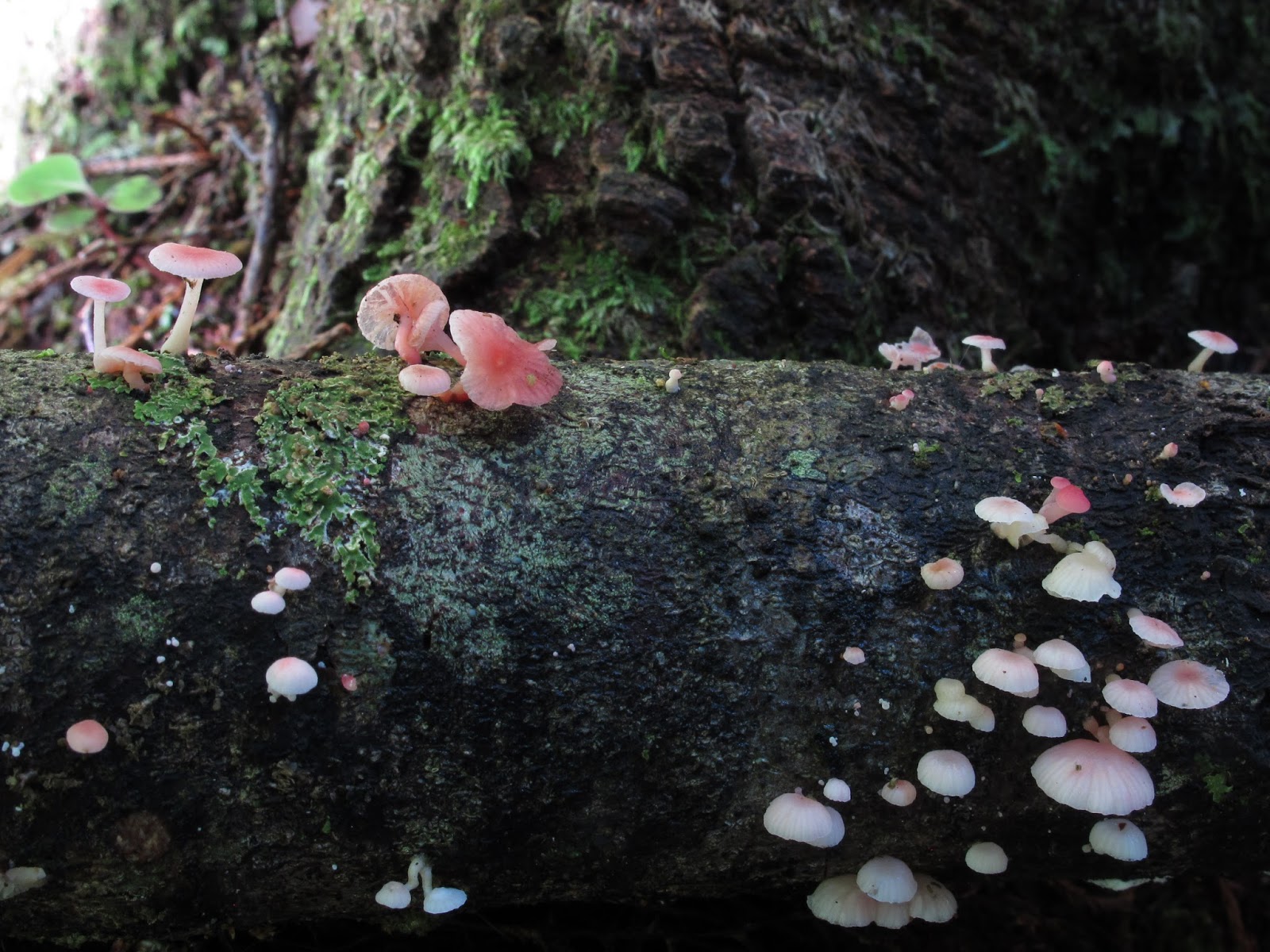


Figure 10: The colours of a good dawn, Mycena roseoflava is often laterally attached and is found on wood. Photo by: SJM McMullan-Fisher, CC-BY-SA
 
Figure 11: Amazing green Mycena flavovirens is not very commonly found. For some reason green is not a common colour for mushrooms. Photo: SJM McMullan-Fisher, CC-BY-SA
Figure 12: This species seems to be less “blue” than when I have seen it in Tasmania and Victoria. Most of the ones I saw on the FunNZ 2013 Foray were faded to this blue grey colour. Need more observations to be sure of this. Photo by: SJM McMullan-Fisher, CC-BY-SA


Figure 13: Congenial foray to Wairata: Roz Hart (left), Petra White, Chantal Probst, Alexandra Ohare, Ann Redpath & Teresa Lebel (Right). Photo by: SJM McMullan-Fisher, CC-BY-SA

Thursday, 6 June 2013

The place of fungi in Aboriginal economic practices


We were privileged at this year's Fungimap Conference to have so many informative and fascinating speakers. Among them was Dr Gary Presland, an authority on Aboriginal history and natural history in Melbourne, Australia and a Fellow of the Royal Historical Society of Victoria. Dr Presland has kindly permitted us to republish his talk here. [Eds.]


The place of fungi in Aboriginal economic practices
 by Dr Gary Presland
 Talk given at Fungimap 7 Conference
 Rawson, 24 May 2013.

Aboriginal economic practices were regular and considered, they were, in fact, an integral part of the human role of maintaining the world as it was given. The movements of Aboriginal people within their estates were time-honoured and measured to take advantage of seasonal occurrence and abundance. But Aborigines were pragmatic and would opportunistically exploit food resources wherever and whenever they were encountered.

It is within these contexts in mind that we should look at the place of fungi in Aboriginal life and economy.

I should say at the beginning, that in Victoria and Tasmania—indeed, in most parts of Australia—there is a dearth of evidence regarding use of fungi by Aboriginal people; looking at Victoria in particular, there are a number of reasons for this:
(1) the rate and extent of disruption to Aboriginal society in  Victoria was such that there was no opportunity to carry out detailed studies on the day-to-day practices of Aboriginal groups in this part of Australia .  There were no anthropologists or the like, that is observers who were trained make sense of a lifestyle that appeared to lack everything that held European society together.
(2) while there was much written during the 19th century about what Aborigines were eating, there is little detail about exactly how it was gathered, when, and where. And there is even less information, of course, relating to species. Moreover, the recorded observations were of a much-changed situation; one in which Indigenous people were fighting to maintain something of their traditional ways and at the same time find a place for themselves in a vastly changed world.
(3) This situation is often exacerbated in the case of Aboriginal use of fungi, and a number of other resources, because the process of gathering the food or material was mostly women’s work.  I say, that not to diminish the economic role of women (which in fact, one can easily show to be paramount), but rather as a comment about the observers. Even those white people who took an interest in Aboriginal matters, paid far less
       attention to what women were doing and more to the activities of men. This was partly because all the observers were themselves men and partly because what the men were doing was more obvious – for eg. hunting, fishing, or cutting bark from trees.

We have, thus, only a partial picture of what Aboriginal people were doing.

What can be said, however, is that within Aboriginal economic practices there were a couple of elements of relevance to any study of Aboriginal use of fungi (Presland 2010). Firstly, seasonal movement was a central feature of the yearly round. Thus bands of perhaps 12 to 20 individuals would work their estates in a way that took them to particular locations at specific times of the year. In Autumn—the time when most fungi were collected—people were moving upwards along river valley, heading toward the higher parts of their territories, where they could shelter from the winter wind and rain.

The second relevant feature of Aboriginal society was that, as hunters and collectors, they applied a sexual division of labour. A part of each day’s economic activity was spent in women gathering plant foods and men hunting game, generally in separate locations. Contrary to popular thought, it was the women who provided the bulk of the day’s foodstuffs, as a result of their gathering. However, almost all the food obtained by either group was brought back to camp for communal consumption.

Considering the size of groups and amount of fungi available suggests that fungi were eaten mostly where and when they were found; we might think of it as something in the way of a snack food. Fruiting bodies may have been taken back to the camp (perhaps if they were abundant) but more likely, they were consumed in the field.

It is probable that there were a number of species—perhaps even a large number—of fungi that were eaten by Aboriginal people. I say eaten because in this part of Australia that’s what observers saw them doing; people weren’t seen using fungi as a source of colour, or as a medication, as recorded in other areas.

Cyttaria gunnii. Photo by Paul George, CC-BY-SA.
Not surprisingly, getting at which species were being used is, in most cases, not an easy matter. As Kalotas (1996) says, in the most-often-referenced piece on the subject of Aboriginal use of fungi, ‘There are only a few fungi in Australia which have been well-documented as being considered edible by Aborigines.’ It is interesting that all of the examples he gives following this quote come from other parts of Australia. However, in this connection he mentions the Beech Orange Cyttaria gunnii.Now, I may be wrong but I think this species fruits in late spring and summer, in which case we have to ask if Aboriginal people were exploiting this source were they doing so in the lower-lying parts of their estates, where nothofagus occurred, or were they moving into high country for the purpose.

The most documented fungus exploited by Aborigines was, of course, Laccocephalum mylittae,often referred to in the past as Blackfella’s bread, or native bread.  There are many references in historical sources to this species in both Tasmania and Victoria. The most interesting references from Tasmania are to be found in the journal of George Augustus Robinson.

Laccocephalum mylittae. Photo by Richard Robinson, CC-BY-SA.

On 30 May 1829, in commenting on the acuteness of the Aborigines’ sight, Robinson wrote:
                I observed them knock off the fungus from the gum tree, which they eat. It has the appearance of wood and has a sweet flavour not unlike mushroom.   There is another sort of fungus belonging to the same tree but which they do not eat.  There is also another sort of fungus which belongs to the she-oak, resembling sponge, of which they also eat.

Referring to native bread which some of his Aboriginal companions had brought him, Robinson wrote on 2 July 1831:

            The natives procure this fungus from under dead or fallen timber, to which it adheres, and  growing in the ground. In size it is as large as a big turnip and in taste it resembles boiled rice.’  He also mentions ‘another fungus from the peppermint tree …; also a white fungus, quite transparent and resembling jelly.

Three months later, Robinson recorded in his diary (on 25 Oct 1831):

            … the natives showed me a dead tree where there was native bread growing: I saw no signs          myself; they smelt the wood and said the plant was a long way in the ground.


In Victoria, similarly there are a number of references to Aboriginal fungi use in 19th century publications. Brough Smyth (1878) wrote that ‘the native truffle (Mylitta Australis) a subterranean fungus, was much sought after by the natives’.  In a passage about  the feeding of children, he wrote:
                 And while very small—but yet able to move about only on hands and knees—it [a child] has a   little stick put into it s hands and, following the example of elder children, it digs for roots, for the   larvae of ants … and sometimes for the native bread (Mylitta Australis) where it is plentiful, and when the elder children are willing to help the little one.

James Dawson (1881) a western district squatter wrote:
                Mushrooms, and several kinds of fungi, are eaten raw; and a large underground fungus, about the   size of an ordinary turnip, called native bread by white people, is eaten uncooked and is very good.

 One of the tree fungus species which Dawson says was eaten by Aborigines has been identified by Beth Gott (1985) as probably a yellow jelly-fungus species, such as Tremella mesenterica.

Tremella mesenterica. Photo by Paul George, CC-BY-SA.
 Henry Tisdal, sometime president of the Field Naturalists Club of Victoria wrote (1886) that Native Bread (at that time called Mylitta Australis):
                are very common in Gippsland, but they are difficult to be obtained, as they only grow underground, and leave, as far as I know, no distinguishing mark to show their whereabouts. I    say as far as I know, but as Mr. Howitt assures me that they are eaten in large quantities by  Aboriginals, they may have some way of finding them.

Well, it can be taken as read that they did. No doubt, in addition to other strategies, Aborigines would have noticed the relationship between fire and the fruiting of this fungus, and made a point of looking out for it.

The fact that this fungus fruits after fire has led (or more correctly mis-led) some people to suggest that Aboriginal firing was aimed at this result. For example, one contributor to the website Australian bushfoods and native medicine forum saw the connection as ‘yet another reason/symbiotic dynamic involved in Aboriginal burning of country.’

On a page of the website Tall trees and mushrooms we can read the statement ‘One can easily imagine that the Aboriginal people would have swept through areas they had burned a couple of days earlier to harvest the scelorotia, which can be quite numerous.’

It is outside of the scope of this paper to explain how wrong these suggestions are. Suffice to say that the burning practices of Aboriginal people at maximizing the yield of a particular range of herbaceous species.  If people saw the occurrence of Native Bread as a result there should be no doubt that they would take advantage of it, but that was not their main intent.

In conclusion, I cannot pass by an example of a web of interconnections involving a number of species, including a fungus.  Gott (1982) notes that one particularly important food orchid for Aboriginal people on the western plains was Gastrodia sesamoides R.Br., called 'native potato'. This plant is completely saprophytic, depending on a fungus for its nutrition. Its position is marked only by the early summer flowering stalk, but when not in flower it was located by Victorian Aborigines by observing where bandicoots had dug for it. Dawson (1881) noted this and was told by local Aborigines that the plant was called 'puewan'.

References
Australian bushfoods and native medicine forum http://www.bushfood.net/forum/
Dawson, J (1881) Australian Aborigines (Melbourne: Walter May & Co.)
Gott B (1982) The ecology of root use by Aborigines of southern Australia. Archaeology in Oceania 17: 59-67
Gott B (1985) Plants mentioned in Dawson’s Australian Aborigines. The Artefact 10: 3-14
Kalatos, A C (1996) Aboriginal knowledge and use of fungi Fungi of Australia vol. 1B Introduction — fungi in the environment  (Canberra: Australian Bureau )
Presland, G (2010) First people: the Eastern Kulin of Melbourne, Port Phillip and central Victoria (Melbourne: Melbourne Museum Publishing)
Tisdall, H T (1886) Fungi of north Gippsland. Part II.  The Victorian Naturalist 3: 106–109


Friday, 26 April 2013

Recognising the Death Cap Mushroom

Last week several Amanita phalloides, known commonly as Death Cap mushrooms, were spotted by staff of the National Herbarium of Victoria growing in a park near the Royal Botanic Gardens, Melbourne, reminding us all that during Fungi Season those in southern Australian states should be cautious about the appearance of Death Caps.


David Catcheside, Creative Commons CC-BY-SA. Amanita phalloides.


Sadly, at least six people have died and at least twelve have fallen ill from eating Death Cap mushrooms in Australia in the past decade. Due to Death Cap's similarity in appearance to an edible straw mushroom that grows in China (Volvariella volvacea), victims have been particularly common in Chinese and South-East Asian communities. Volvariella volvacea is not known to grow wild anywhere in Australia.
The Death Cap Mushroom is widespread under oak trees in southeast Australia, but there is concern among mycologists and toxicologists that it may develop the ability to grow in association with other trees, particularly Australian natives, and thereby spread dramatically.

How to Recognise the deadly Amanita phalloides:
Atlas of Living Australia, Distribution of Amanita phalloides as of April 26 2013.
It has a yellowish to greenish cap, sometimes brownish (typically olive-green in the centre and becoming yellowish-green towards the margin) and white, free gills. The white central stem usually has a ring, and at its base there is a large, membranous, cup-like volva.You can see the cup-like volva at the base of the mushrooms in the photo above, where it has been excavated from the soil. If you pull up the specimen to check out this characteristic, do so carefully - preferably using gloves - and wash your hands thoroughly afterwards.  

Amanita phalloides usually grows on its own or in sparse groups below oak trees (Quercus spp.), but has on rare occasionas also been spotted in large groups. It is found in southern Australian states from southern Western Australia through to New South Wales, but its territory may be expanding. A map of known sightings is above.

It has a white spore print. To take a spore print, place the the cap (or a piece of cap) gills down on a black  piece of paper and leave it for two to three hours. The gills will drop enough spores to give you a coloured print, and if it shows up white against the black paper that is a good indication - taken together with the other characteristics - that it is a Death Cap.

Look-alikes: The similar-looking Smooth White Parasol Leucoagaricus leucothites has no green colour in the cap and no volva. Common Rosegill Volvariella speciosa has no green colour in the cap, no ring and a pink-brown spore print.

 Further excellent information on how to identify the Death Cap can be found on the Australian Botanic Gardens website here: http://www.anbg.gov.au/fungi/deathcap.html .

Even if you don't suspect it to be a Death Cap, note that there are many other poisonous mushrooms in Australia!  
In a poisoning emergency phone 
13 11 26
24 hours a day, 7 days a week,
Australia wide

Monday, 18 March 2013

Early Bird Discount for Fungimap 7 Conference Closing Soon

Only 10 weeks to go until Fungimap 7!

Registrations for Fungimap 7 are selling out fast - make sure to get in before Easter to secure the Early Bird discounted prices (closes 28 March at 5pm). Another reason to get in early - some of the workshops are almost full so make sure you get your first preferences by booking now; Simone Louwhoff's workshop on lichen identification and Roy Halling's workshop on boletes are proving especially popular.

We’re excited to announce that Professor Tim Entwisle, the new Director of the Royal Botanic Gardens, Melbourne will open the Fungimap 7 Conference on May 24th. Professor Entwisle is an expert in freshwater algae, and has a special history with Fungimap, having provided advice and comments during the production of the FNCV Fungi Kit. He is also an exceptional science communicator, former Executive Director of the Botanic Gardens Trust, Sydney, and former Director of Conservation, Living Collections and Estates, at Kew Gardens, London. We are looking forward to hearing his global perspective and insights into the future of Australian fungi!

Other new additions to the Fungimap 7 program include ‘Target Species Bingo’ on Thursday night to kick us off for the weekend - brush up on your skills in recognising the target species to dominate the competition and win some great prizes. We’ve also got some fascinating student presentations happening on Sunday night, including Rebecca Le Get from LaTrobe University who will talk about the relationship between prior land use and mushroom diversity, as well as a brief talk by the Tarra Bulga Parks Victoria Ranger during Monday’s foray. 

Victoria has finally received some rain! We hope you’re getting rain where you are too, to bring out the fungi!

From top-left: Three species likely to be seen this year at Rawson:  Amanita muscaria, Calostoma fuscum, and Mycena interrupta. Images provided under Creative Commons 3.0 Australia : CC-BY-SA - Attribution Share-Alike.